
.png)

.png)
.png) 4
4 .png)
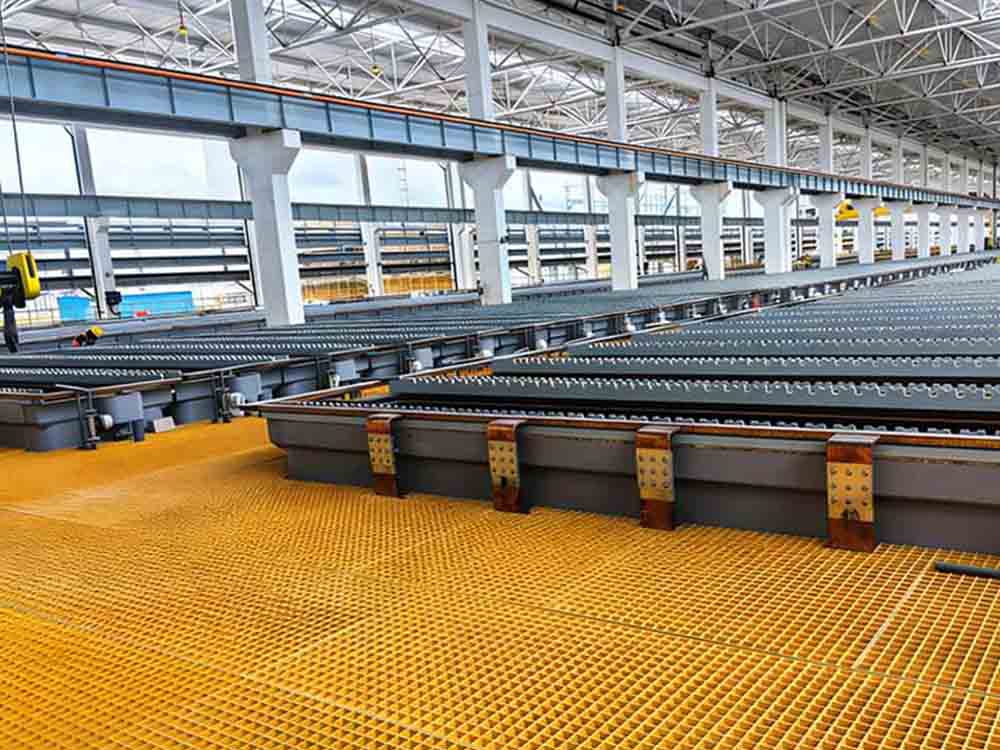
Common molded grating is manufactured through an integral molding process. During production, glass fibers are interwoven in both warp and weft directions, uniformly impregnated with resin, and then integrally shaped under high temperature and high pressure. The fibers uniformly penetrate every area of the entire panel, with balanced distribution and consistent density in the two vertical and horizontal stress directions. Therefore, the bidirectional mechanical properties of the material are nearly identical, with little difference in bending, tensile and compressive strength in all directions. It has excellent overall structural toughness, outstanding impact resistance and fatigue resistance, and is not prone to local damage or fracture. Its grid is an integrally formed structure without any splicing gaps, and it has good anti-corrosion, moisture-proof and acid-alkali resistance, adapting to a variety of harsh working conditions. However, limited by the characteristics of the molding process, the overall rigidity of the molded grating is relatively low, which is prone to deflection deformation in large-span and high-load application scenarios, and its load-bearing capacity is limited. Therefore, it is more widely used in conventional light-load and daily passage scenarios such as ordinary walkways, trench covers, light-duty anti-corrosion platforms, sewage treatment plant walkways, and civil building balcony railings. Pultruded grating is formed by continuous traction and pultrusion of glass fiber bundles. During production, the glass fiber bundles are impregnated with resin, then continuously drawn and cured in a special mold. Its main load-bearing ribs are only arranged longitudinally, and the glass fibers are highly concentrated along the length direction of the ribs. This makes its longitudinal load-bearing capacity, bending resistance and rigidity very prominent, and its strength and rigidity are much higher than those of ordinary molded grating, which can easily adapt to large-span and heavy-load application environments, and is not easy to deform under long-term load. However, the transverse part of the pultruded grating only relies on thin round rods or flat steel for mechanical connection and fixation, without continuous reinforced fibers, so its transverse mechanical performance is extremely weak, and there is a huge difference in mechanical performance between the longitudinal and transverse directions. Therefore, pultruded grating is mainly applied to heavy-duty equipment platforms, long-span walkways and other occasions with high load-bearing requirements.
.png) Prev
Prev
.png)
.png)









.png)