
.png)

.png)
.png) 325
325 .png)
Introduction
When designing industrial walkways, offshore platforms, chemical plants or renewable energy facilities, choosing the right flooring material is critical for safety, durability and long-term maintenance costs.
Traditional steel grating has been the industry standard for decades. However, corrosion, high maintenance requirements and heavy weight have driven many industries toward a better alternative—FRP grating.
So, what is FRP grating? How does it compare with steel grating? Which industries benefit the most from it?
In this guide, we’ll explain everything you need to know about FRP grating, including its manufacturing process, advantages, applications and how to choose the right supplier.
What Is FRP Grating?
FRP (Fiber Reinforced Plastic) Grating is a high-performance composite grating manufactured by combining glass fibers with thermosetting resin systems.
Unlike metal grating, FRP grating does not rust, corrode or require frequent painting. It offers exceptional strength while remaining significantly lighter than steel.
The combination of fiberglass reinforcement and premium resin creates a material that is:
- Corrosion resistant
- Lightweight
- High strength
- Slip resistant
- Electrically non-conductive
- Fire retardant
- UV resistant
- Low maintenance
These characteristics make FRP grating an ideal solution for aggressive industrial environments where traditional steel products struggle to maintain performance.
How Is FRP Grating Manufactured?
FRP grating is generally produced using one of two manufacturing methods.
Molded FRP Grating
Molded grating is manufactured by laying continuous fiberglass rovings into an open mold in multiple directions. The mold is then filled with resin and cured under controlled conditions.
Advantages include:
- Excellent corrosion resistance
- Bi-directional strength
- Easy fabrication
- Ideal for chemical plants and wastewater treatment facilities
Pultruded FRP Grating
Pultruded grating is produced using a continuous pultrusion process where fiberglass reinforcements are saturated with resin and pulled through heated dies.
Compared with molded grating, pultruded grating provides:
- Higher load-bearing capacity
- Longer span capability
- Greater stiffness
- Lower deflection
Pultruded grating is widely used for offshore platforms, bridges, heavy-duty walkways and infrastructure projects.
Major Applications of FRP Grating
Because of its exceptional durability, FRP grating is used across many industries.
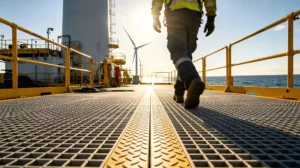
Offshore Wind Farms
Marine environments expose equipment to salt spray, humidity and UV radiation.
FRP grating provides:
- Corrosion resistance
- Long service life
- Lightweight installation
- Reduced maintenance
Offshore Oil & Gas Platforms
Safety is critical on offshore facilities.
FRP grating offers:
- Anti-slip surface
- Fire-retardant properties
- Excellent structural performance
- Reduced maintenance shutdowns
Why Choose Endura FRP Grating?
At Endura, we specialize in designing and manufacturing high-performance FRP grating engineered for demanding industrial environments.
Our products are widely used in:
- Offshore wind platforms
- Offshore substations
- Oil & gas facilities
- Marine engineering
- Chemical processing plants
- Industrial walkways
What Makes Endura Different?
✔ Advanced resin formulation for harsh environments
✔ Strict quality control throughout production
✔ Custom dimensions and engineering support
✔ High load-bearing performance
✔ UV-resistant and fire-retardant options
✔ Global project experience
With years of expertise in composite materials, Endura provides reliable solutions that help customers reduce maintenance costs while improving operational safety.
.png) Prev
Prev
.png)
.png)









.png)